
By Adeyinka Adeniran
Nigeria has renewed its call for a permanent seat for Africa on the United Nations Security Council, insisting that the current structure of the world body, designed in 1945, can no longer adequately represent the realities of 2026.
This position was made known in a national statement delivered by Vice President Kashim Shettima on behalf of President Bola Ahmed Tinubu at the General Debate of the 81st United Nations General Assembly held in New York on 24 September 2026.
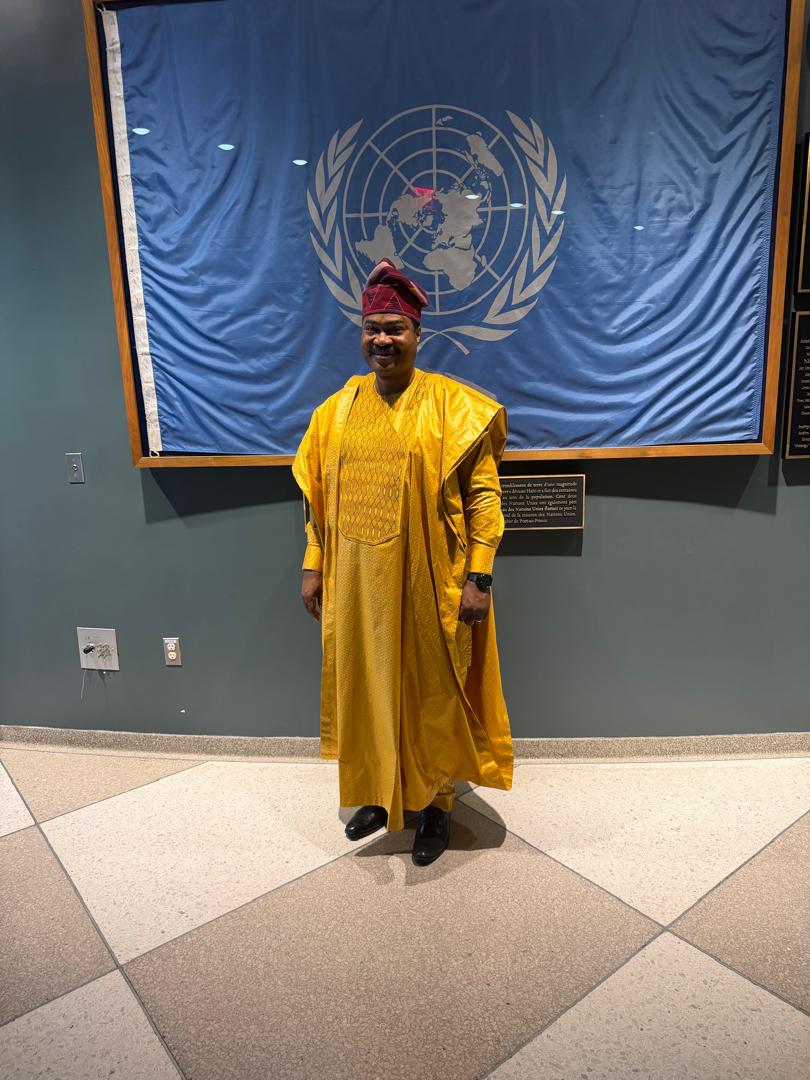
The statement, which forms the subject of a detailed review by Ambassador Bolaji Akinremi, MD/CEO of The Organizers Concept (TOC), has been described as one that “deserves serious attention as an articulation of Nigeria’s national interests, global responsibilities and development aspirations.”
According to Ambassador Akinremi, the address was “not merely a catalogue of international concerns” but a deliberate attempt to connect Nigeria’s domestic priorities with the wider questions confronting the international community.
The Vice President, who was constitutionally mandated by President Tinubu to lead Nigeria’s delegation to UNGA 81 and represent him at the high-level gathering, used the platform to press home Africa’s demand for at least two permanent seats on the Security Council, complete with the full rights and responsibilities of permanent membership, including the veto, alongside additional non-permanent representation for the continent.
The Diplomat who was unequivocal in his assessment of the significance of this position, noted that it is “not simply an African aspiration” but “a direct assertion of Nigeria’s longstanding position that Africa should have a greater voice in the institutions responsible for global peace and security.”
On the economy, Ambassador Akinremi observed that “a major strength of Nigeria’s presentation was the connection it established between national development and international action.”
He noted that the Vice President presented Nigeria’s economic direction as one built around “sound macroeconomic management, stronger institutions, private-sector development and strategic public investment,” while linking these domestic objectives to sustainable development and Africa’s wider economic transformation.
Additionally, he said the statement also placed the African Continental Free Trade Area at the centre of the continent’s economic future, making the case for a shift away from raw-material dependence towards value addition, manufacturing, technological innovation and knowledge-driven growth.
On climate change, Ambassador Akinremi noted that Nigeria “rejected the false choice between development and climate action,” reaffirming the country’s commitment to the Paris Agreement and its objective of achieving net-zero emissions by 2060.
The statement stressed the importance of energy access, gas as a transitional fuel, renewable energy, clean cooking, climate-smart agriculture, technology transfer and climate finance in helping developing countries like Nigeria meet their climate obligations without sacrificing growth.
On technology, the review noted that Nigeria’s statement “moved beyond abstract discussion of AI risks” to present the country as one seeking to harness artificial intelligence for healthcare, education, agriculture, governance and productivity, positioning Nigeria as an active participant in shaping the technological future rather than a passive observer of it.
Nigeria’s contribution to regional and international peace and security also featured prominently in the address, with references to the country’s role in peacekeeping missions in Liberia, Sierra Leone, Darfur, Mali and The Gambia, as well as its continuing engagement through ECOWAS, the African Union and Gulf of Guinea partnerships.
Ambassador Akinremi noted that Nigeria’s approach to counterterrorism was “presented as extending beyond military action to education, economic opportunity, accountable governance and protection of citizens’ rights and dignity,” a framing that places security within the broader context of development and inclusive governance.
On the pressing issue of development finance, the Vice President used the UN platform to draw attention to the burden that debt servicing places on education, healthcare and infrastructure in developing countries, calling for wider access to concessional financing, sustainable debt frameworks, blended finance, private capital and South-South cooperation.
Ambassador Akinremi framed this as evidence that “Nigeria’s UN diplomacy was presented not as diplomacy detached from economic realities, but as an extension of its development strategy.”
Nigeria also reaffirmed its commitment to the peaceful settlement of disputes, respect for sovereignty and territorial integrity, international humanitarian law and the protection of civilians, with specific references to Sudan and other ongoing conflicts, demonstrating what Ambassador Akinremi described as an attempt to position Nigeria “not merely as an observer of global crises but as a country with a continuing interest in mediation, peacebuilding and African-led solutions.”
Drawing a comparison between Nigeria’s statement and those of Senegal and Fiji, Ambassador Akinremi noted that while Senegal’s presentation emphasized multilateralism, Security Council reform, regional security, development and financial reform, and Fiji’s address focused understandably on climate vulnerability, sea-level rise and the protection of small-island states, Nigeria’s statement “had a broader structural character,” combining Security Council reform, peace and security, economic reform, development finance, climate transition, artificial intelligence, AfCFTA, industrialization, counterterrorism and regional integration into a single, coherent presentation.
He was careful to note that the comparison was not about which country’s statement was rhetorically superior, but about how effectively each nation used the platform to project its own particular circumstances and strategic interests, concluding that “measured against that standard, Nigeria’s statement had considerable breadth and strategic coherence.”
Situating the statement within Nigeria’s domestic political context, Ambassador Akinremi observed that it “should be read as an expression of the administration’s broader national policy direction rather than as an isolated diplomatic speech,” and commended the Tinubu-Shettima leadership for presenting Nigeria’s domestic reform agenda as part of a wider programme of international engagement.
However, he was equally firm in cautioning that words alone are not enough, as According to him, “the strongest assessment of any national statement should ultimately rest not only on its language but on the implementation of the commitments it contains.”
Concluding his review, Ambassador Akinremi stated that Nigeria’s presentation at UNGA 81 demonstrated that “a national statement can serve simultaneously as a diplomatic instrument, an economic prospectus, a security doctrine and a declaration of national aspiration,” with its central message being that Nigeria “seeks to participate actively in shaping — not merely responding to — the emerging international order.”
He added that the real significance of the statement lies in the alignment it sought to establish between Nigeria’s domestic transformation, Africa’s development, global governance reform and international cooperation, noting that in the context of an assembly explicitly focused on restoring trust in the United Nations, Nigeria’s presentation placed its own reform and development ambitions firmly within that global conversation.
In his final assessment, Ambassador Akinremi stated that “the enduring test… will be whether the commitments articulated in New York are translated into measurable outcomes at home, across Africa and through Nigeria’s multilateral diplomacy,” concluding that “that is where national leadership ultimately meets global responsibility.”