
By Adeyinka Adeniran
United Nations Children Fund (UNICEF) has called on governors and stakeholders in the Southwest states to key into Child Nutrition Fund, described as low-hanging fruit that every state must take advantage of, to secure sustainable financing for nutrition interventions and realize the right of the child in this sector.
The Program Manager at UNICEF Nigeria, Lagos Field Office, Muhammed Okorie gave the charge in a sideline interview during a “One day high-level meeting on Integrated Multisectoral Nutrition Programming in States of Southwest geo-political region.”
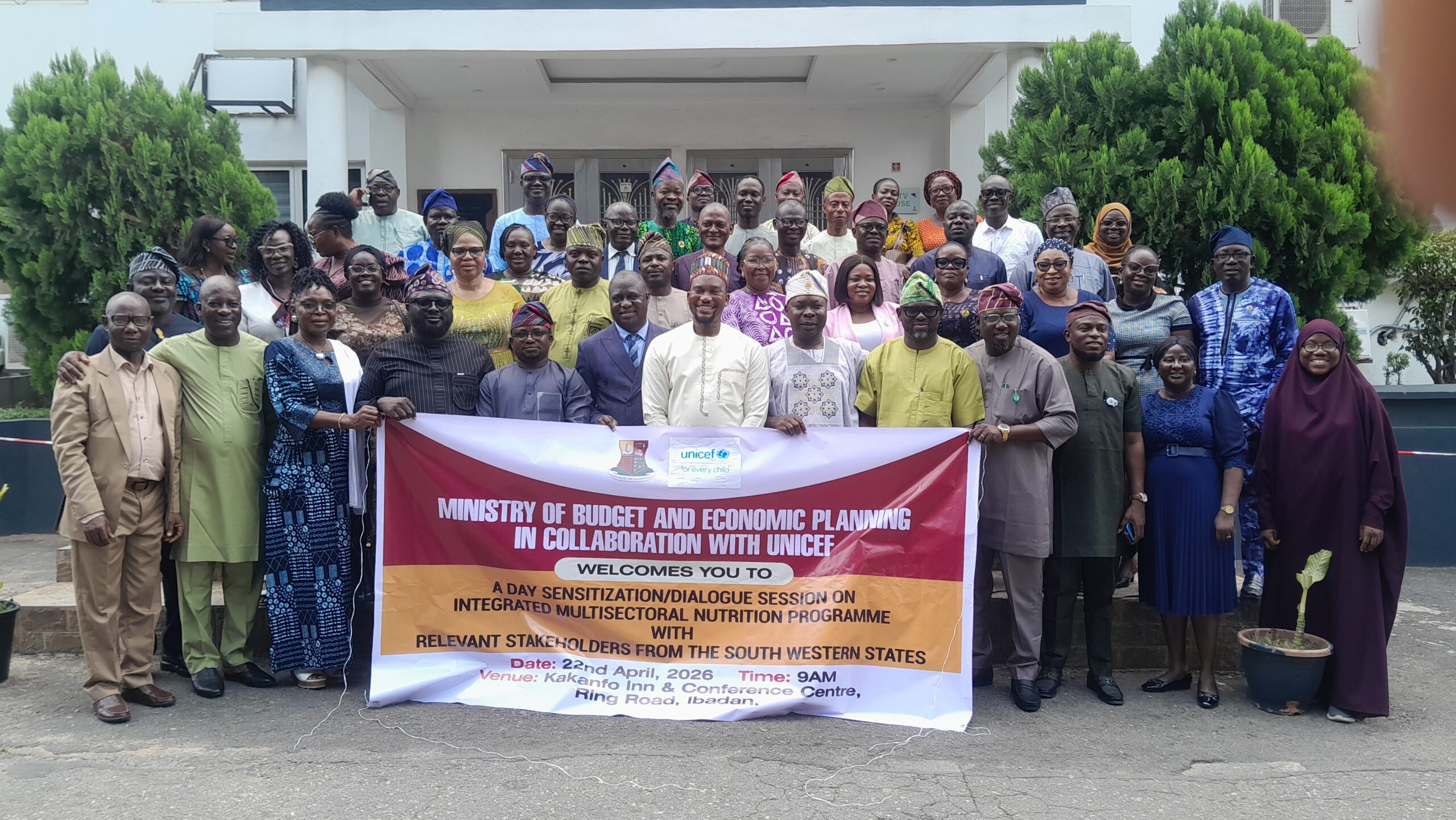
The meeting which seeks to operationally the N-774 Initiative and establishment of local governments committees on food and nutrition (LGCFNs), held at the Kakanfo Inn, Ibadan drew participants from Ekiti, Ogun, Ondo, Osun and Oyo State.
The meeting also focuses on situation analysis, strategic directions, resource mobilisation, governance and accountability. The participants include: Permanent Secretaries of relevant line ministries, and Executive Secretaries of State Primary Healthcare Management Boards/Agencies.
Speaking, Okorie stressed that nutrition is critically important because failing to address it deprives children of vital intellectual capabilities, and the effects are irreversible.
He said the key window for intervention is the first 1000 days of life, beginning with exclusive breastfeeding and followed by appropriate complementary feeding. He warned that stunting remains a major challenge, as its impact on a child’s cognitive development cannot be reversed, which makes early action essential.
To address nutrition, he noted that the Federal Government has inaugurated the N774 system to create coordinated institutional structures across federal, state, and local government levels, noting that the platforms are meant to strengthen multisectoral planning, budgeting, coordination, and peer review mechanisms for nutrition.
He disclosed that, a critical financing tool within the framework is the Child Nutrition Fund, where UNICEF matches any amount a state budgets specifically for nutrition commodities.
He said, “For example, if a state dedicates N100 million, UNICEF matches it to make N200 million.”
He urged all Southwest states to make CNF an integral part of annual budgets, stressing that stunting has irreversible consequences on a child’s intellectual capabilities and must be addressed in the first 1000 days of life through exclusive breastfeeding and adequate complementary feeding.
Okorie noted that while the Southwest average for stunting stands at 21.5 percent, as some states are as high as 30 percent, with others at 23 and 22 percent. He pointed that one state at 17.2 percent but with over two million children affected due to its population size.
He called for multisectoral action involving agriculture, health, education and social protection, adding that local government committees on food and nutrition are now being set up to complement state structures under the N774 framework.
He warned that donor support is not guaranteed forever and advised states to key into the CNF now, stating that there is no cap on the matching fund and that the amount a state commits determines what it gets in return.
He noted that progress on the Child Nutrition Fund varies by state, stressing that while some states in the Southwest have already moved through the full cycle of budgeting, approval, release, and procurement, with UNICEF matching the funds and commodities already disbursed to children, others are at different stages.
Also speaking, the House Committee Chairman on Nutrition and Food Security in the Oyo State House of Assembly, Dr. Babaola Abiodun, described nutrition as a strong pillar for total human development that impacts human capital and economic growth.
He said the legislature has a critical role to play in passing laws that strengthen nutrition for children and adults and in ensuring budgetary allocations to back implementation.
While assessing Oyo State’s efforts, he stated that the state is driving nutrition issues strongly and cited the governor’s approval of six months extra pay for workers and a motion before the House seeking paternity leave for men to ensure children receive total care and nutrition.
In his remarks, The Permanent Secretary, Ministry of Budget and Economic Planning and Chairman of the State Committee on Food and Nutrition, Mr Tunde Ayanleke, said the ministry coordinates nutrition activities across Ministries, Departments and Agencies and holds quarterly meetings of the state committee.
He revealed that Oyo State last year accessed N235 million in counterpart funding for the Child Nutrition Fund, a UNICEF-matching grant mechanism, making it the only Southwest state to do so in 2023.
He added that the commodities procured were distributed free to residents, with a flag-off held at Ibadan North East two months ago, adding that the state is working towards a budget of N300 million this year to draw another N300 million from UNICEF, to make a total of N600 million for nutrition commodities before mid-year.
On impact, he said stunting in the state dropped from around 37 percent a few years ago to 23.1 percent in the 2024 MICS survey, with expectations of further decline following ongoing interventions and the next MICS survey.
Also speaking, the Chairman Odeda local government who doubles as the Association of Local Government of Nigeria (ALGO) Chairman, Ogu state, Dr Folasade Adeyemo said nutrition remains basic to human life and must be tackled headlong because without it a child cannot function effectively.
She noted that the N774 initiative of the Federal Government cuts across all 774 local government areas and disclosed that local councils in the state are ready to partner with the Federal Government not only in words but also in implementation, adding that plans are ongoing to ensure the success of the programme.