
By Adeyinka Adeniran
The Federal Government as well as stakeholders in the horticulture sector have listed the gains the sector is making in recent times with the active collaboration of relevant partners.
Minister of Agriculture and Food Security, Dr. Aliyu Abdullahi, said, there has been a 93% increase in crop yields, a 205% rise in farmer incomes, and more than 76,000 farmers trained with women and youth far exceeding original participation targets.
Additionally, he said, nearly 900 horticulture-related MSMEs have been supported, with improved capacities in agricultural practices, financial literacy, and business development.
He added that, more than €4.1 million in finance has been facilitated, 477 new jobs and businesses created, with youth accounting for 70% of these opportunities.
He particularly said the various achievements were made possible with the active collaboration of HortiNigeria, which he said has been catalystic in facilitating sustainable and inclusive growth across Kaduna, Kano, Ogun, and Oyo States.
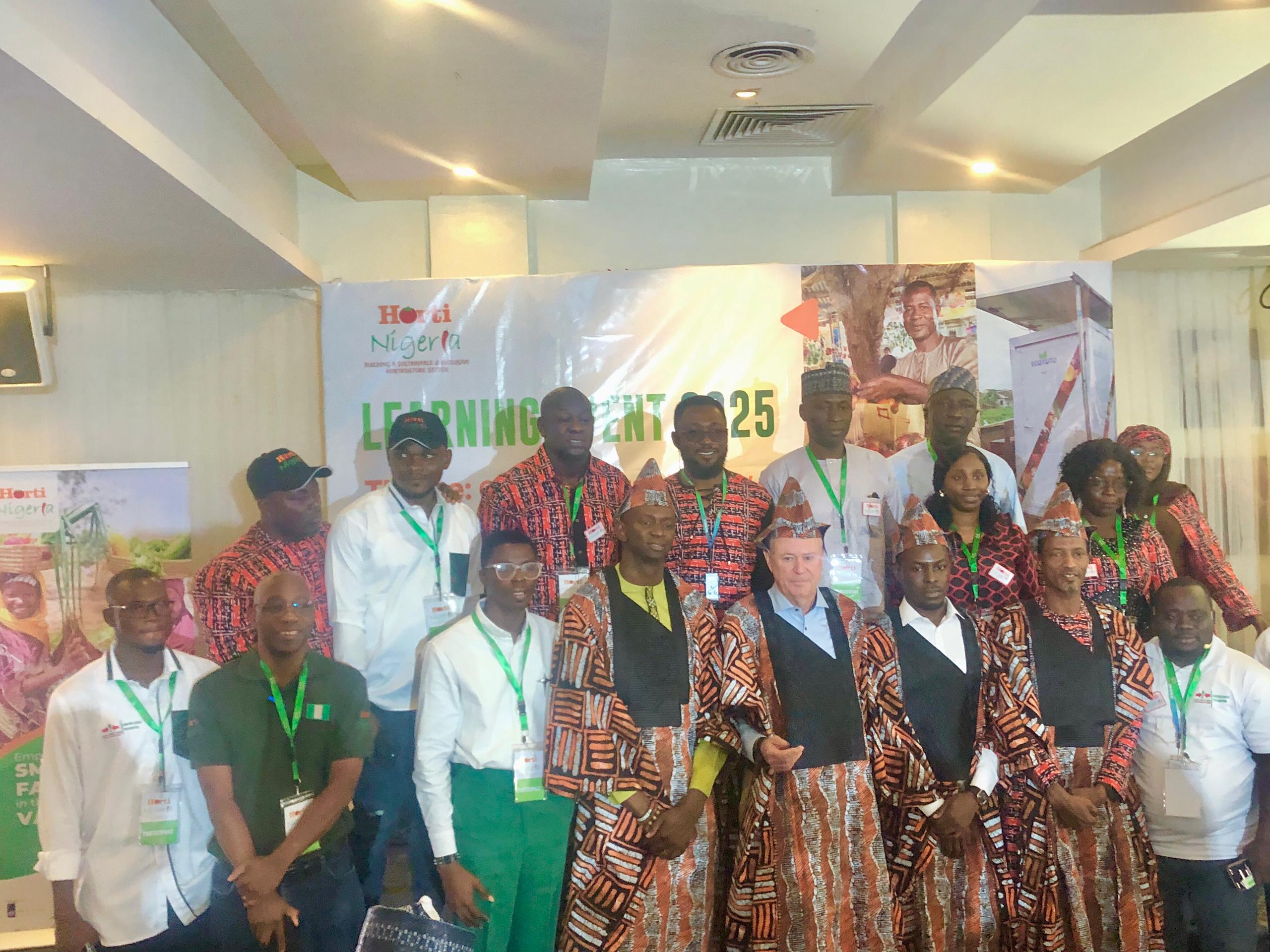
Dr Abdullahi spoke while delivering the keynote address in Ibadan during the Learning Event 2025 of the HortiNigeria programme, themed “Catalysing Sustainability and Inclusion through Stakeholder Engagement in Nigeria’s Horticulture Sector.”
The event saw policymakers, government officials, development partners, and industry stakeholders calling for stronger collaboration, enabling policies, and increased investment to drive sustainability and inclusion in Nigeria’s horticulture sector.
The HortiNigeria programme (2021–2025), funded by the Embassy of the Kingdom of the Netherlands, is led by the International Fertilizer Development Center (IFDC) and implemented in partnership with the East-West Seed Knowledge Transfer Foundation, the Royal Tropical Institute (KIT), and Wageningen University & Research.
With a €9.7 million budget, the programme has focused on improving food security, empowering smallholder farmers, and promoting sustainability, with particular emphasis on women and youth.
The Minister who was represented by the Director of Horticulture at the Ministry, Mr. Yerima Ubah, highlighted the programme’s impact, said, “HortiNigeria has been catalytic in facilitating sustainable and inclusive growth across Kaduna, Kano, Ogun, and Oyo States.
“We have seen a 93% increase in crop yields, a 205% rise in farmer incomes, and more than 76,000 farmers trained with women and youth far exceeding original participation targets. This confirms that horticulture is not only boosting productivity but also empowering women and creating dignified opportunities for our young people.
“Nearly 900 horticulture-related MSMEs have been supported, with improved capacities in agricultural practices, financial literacy, and business development. More than €4.1 million in finance has been facilitated, and 477 new jobs and businesses created, with youth accounting for 70% of these opportunities.
“Beyond numbers, the programme has reduced post-harvest losses by an extraordinary 83%, injected over 23,000 plastic crates into Mile 12 Market for tomato handling, and piloted solar-powered irrigation systems to help farmers adapt to climate change. It has also supported policy reforms in seeds, tomatoes, and organic agriculture, while securing higher credit-risk guarantees for farmers.
“These achievements are worth celebrating, but they also remind us that the journey is far from over. We still face rising input costs, climate change, insecurity, and land conflicts. However, the successes of HortiNigeria show that with the right partnerships, innovation, and enabling policies, these challenges can be overcome.
“Our vision remains clear, to build a sustainable horticulture sector that drives food and nutrition security, creates jobs, empowers women, and enhances Nigeria’s competitiveness in global markets.”
In his speech, the Dutch Ambassador to Nigeria, Bengt Van Loosdrecht, reaffirmed his country’s commitment to agricultural partnerships.
He said, “The Netherlands is one of the world’s leading agricultural producers, second only to the United States. We are always interested in making investments in other countries, and Nigeria has both the population and the resources to become a hub for horticulture. From the data we’ve seen, Nigerian consumers are increasingly demanding quality products, and that gives us a strong basis to scale up.
“We are ready to work with the Nigerian government on building policies and systems that will take horticulture from potential to prosperity.”
Representing the Ministry of Budget and National Planning, Dr. Juliet Agu, Assistant Director, Bilateral Economic Cooperations also stressed the importance of embedding horticulture into Nigeria’s long-term agenda.
“Horticulture is no longer just a subsector, it is a driver of jobs, nutrition, and trade. We must ensure the lessons from HortiNigeria are scaled beyond the lifespan of the programme. This means embedding horticulture firmly into Nigeria’s long-term economic and development planning. That is the only way to sustain the gains achieved so far.”
Also, representing Governor Seyi Makinde, the Permanent Secretary for Agriculture, Mrs. Abosede Owoeye, reaffirmed Oyo State’s partnership.
“Oyo State is proud to be at the forefront of this effort. Through our partnership with HortiNigeria, especially via OYSADA, we are repositioning the value chain to empower families, strengthen public-private collaboration, and bridge the gap between knowledge and practice. This will help revitalise agriculture for the next generation.”
On behalf of Governor Dapo Abiodun, the Permanent Secretary for Agriculture and Food Safety, Mrs. Kehinde Jokotoye, praised the programme’s impact. She said, “HortiNigeria has shown what is possible when partnerships are built around shared goals. For Ogun State, horticulture is not just about food production, but about creating jobs, building enterprises, and ensuring that women and youth are at the centre of agricultural transformation.
“We are committed to sustaining this momentum, scaling up innovations, and aligning with programmes that place people and sustainability at the heart of agriculture.”
Earlier in his welcome address, Mohammed Salasi Idris, HortiNigeria Program Director, reflected on the programme’s journey since its inception.
“We are not only here to celebrate, but to reflect and chart a way forward for horticulture in Nigeria. We want to ask ourselves what worked, what didn’t work, and how we can build on the successes.
“Since 2021, we have supported over 70,000 farmers, connecting them to markets, building skills, and strengthening small-scale producers. HortiNigeria is not just about farming, it’s about creating jobs and transforming livelihoods.
“We need to move from aid to trade. Nigeria can double its horticultural exports by 2030 if we invest in innovation, climate-smart practices, and greenhouse technologies. Horticulture can become the engine room of agricultural transformation.”