
By Adeyinka Adeniran
Journalists and editors in Oyo State have been challenged to make fact-checking and democratic accountability the core of their coverage as Nigeria approaches the 2027 general elections, rather than mere event-driven reporting of political activities.
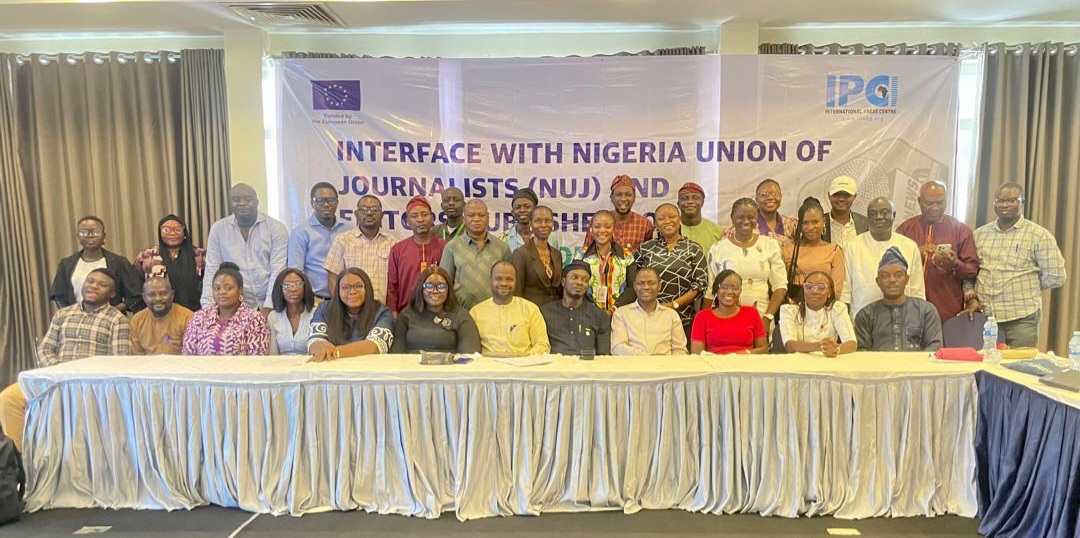
The call came at a two-day interface with members of the Nigeria Union of Journalists and online editors/publishers on professional and democratic accountability journalism, organised by the International Press Centre (IPC) under Component 4 of the European Union Support to Democratic Governance in Nigeria (EU-SDGNIII) Programme. The event held in Ibadan on Monday and Tuesday.
Delivering the welcome remarks, IPC Executive Director, Lanre Arogundade, said, the media must move beyond covering campaigns, rallies and results to interrogating promises, verifying claims and amplifying citizens’ real concerns.
“An election period characterised by sensationalism, unverified claims, inflammatory rhetoric, and the unchecked spread of misinformation and disinformation can undermine public confidence, deepen social divisions, and weaken democratic institutions.
“Conversely, a media environment that prioritises accuracy, fairness, verification, conflict-sensitive reporting, and accountability can strengthen public trust and contribute to peaceful, credible, and inclusive elections”, Arogundade said.
Arogundade’s remarks concluded that the success of the engagement would ultimately be measured not by attendance or discussions alone, but by the quality of stories published, claims verified and citizens’ voices amplified in the months ahead of 2027.
In his presentation, NDR/IPC Factchecker, Olusola Oludiran said fact-checking can no longer be treated as an optional extra, noting that the information space has become heavily compromised by inaccurate narratives, making rigorous verification essential to the media’s role as the fourth estate.
“The media cannot be said to be performing its role without serving as sanitiser to the much-tainted information space, especially in the fast-paced information ecosystem eroded with false information. Hence the need to integrate factchecking into its operationality,” Oludiran said.
He defined fact-checking as the provision of accurate, unbiased analysis of public statements and claims in order to correct misperceptions, stressing that it is more rigorous and investigative than routine news writing.
Information disorder, he explained, encompasses misinformation (false content shared without intent to deceive), disinformation (deliberately fabricated content meant to harm) and malinformation (genuine information used maliciously out of context).
Electoral misinformation, Oludiran warned, carries direct costs: voter suppression through false details about polling, delegitimisation of results, incitement of violence, and erosion of trust in institutions such as INEC. In the AI era, deepfakes, cloned voices and synthetic images have made the threat faster and more convincing.
Also, the guest lecturer, Dr Taiwo Adisa, in a presentation on scanning the electoral environment and reporting citizens’ priority concerns, linked the challenge to a broader “democracy paradox” in which citizens feel disillusioned by the gap between democratic promises and delivery.
Journalists, he argued, must act as auditors, gatekeepers and ombudsmen to straighten democracy’s “crooked legs.”
He observed that despite the extended campaign window under the Electoral Act, many parties and candidates remain largely in “mute mode,” still constituting campaign committees weeks after the official start. “Why are our politicians shying away from meeting the people, engaging them, unveiling their manifesto and providing alternative policy initiatives?”
“You, as democratically responsible journalists, must put the question to the party leaders and the candidates.”
On Oyo State specifically, Adisa noted high political awareness, a crowded field of 16 governorship candidates, a vibrant media landscape of over 50 radio stations and numerous online platforms, and persistent citizen priorities around free or affordable education, agriculture, rural roads, security and healthcare.
He urged journalists to resist the monetisation of grassroots demands and instead help communities focus on substantive issues of governance and legislation.
The interface stressed that fact-checking should target verifiable claims—statistics, declarative statements, doctored media and public-interest assertions—while opinions, predictions and private conversations generally fall outside its scope.
Participants were reminded of the ABC cycle: Assume nothing, Believe nothing, Check everything.