
By Adeyinka Adeniran
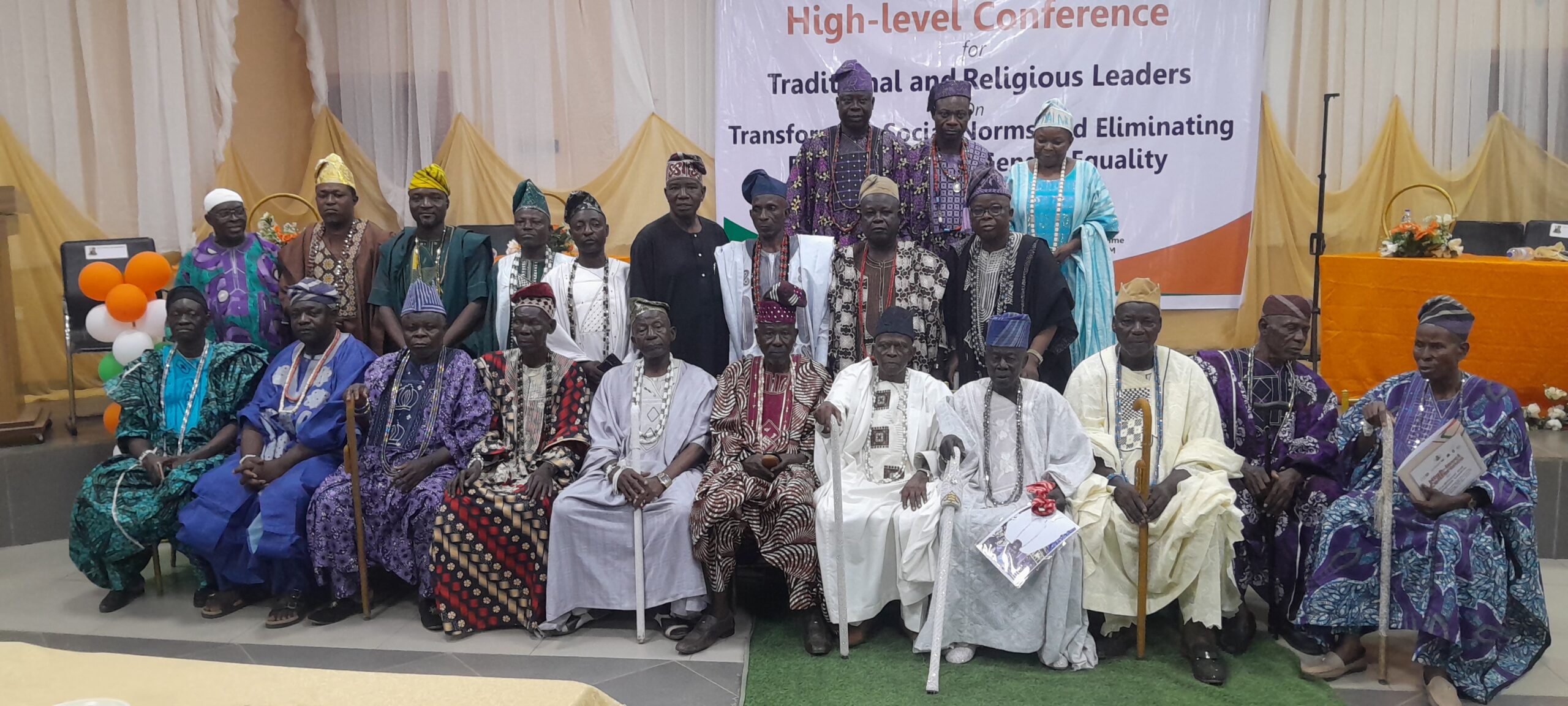
Stakeholders including traditional rulers, religious leaders, representatives of government ministries and agencies, civil society organisations, professional bodies, women’s and youth groups, and development partners on Monday signed a pact to ending the practice of Female Genital Mutilation and Cutting (FGM/C) in Oyo State.
They reached the agreement during an high-level conference for traditional and religious leaders on transforming social norms and eliminating FGM to promote gender equality in Ibadan, Oyo State.
The conference which held at the Local Government Training School Hall, Oyo state government Secretariat, Agodi, Ibadan was convened by the Centre for Comprehensive Promotion of Reproductive Health (CCPRH) with support from UNFPA and in collaboration with relevant Oyo state institutions.
The stakeholders said the move was guided by the shared cultural, spiritual, and moral values, which required all to protect the dignity, health, and well-being of every child.
In the separate remarks, the stakeholders said they are aware that FGM is not required by any holy scripture, and is recognised internationally and nationally as a harmful practice and a violation of the rights of women and girls, adding that Nigeria’s commitments under SDG 5.3 to eliminate harmful practices, including FGM, and existing national and state legal frameworks prohibiting FGM.
Speaking in his welcome address, the Executive Director, CCPRH, Professor Oladosu Ojengbede said the high level meeting was called in acknowledging the encouraging decline in FGM prevalence in Oyo State, while also recognising that too many girls and women remain at risk or affected.
On the prevalence and trend, the Professor of Obstetrics and Gynaecology noted that available data show that while FGM is declining in Oyo State, the practice remains significant, especially in some communities and LGAs within Oyo and beyond.
He lamented that cutting is increasingly done at younger ages, often before girls can speak for themselves, adding that FGM persists due to social norms and expectations, misconceptions about religion and morality, gender inequality and control over girls’ bodies, as well as economic and status factors linked to traditional roles.
He said, FGM causes serious health, psychological, social and spiritual harm and is prohibited by law, adding that it undermines education, economic opportunities and community development, and contradicts the core values of our faiths and cultural heritage.
Harping on the role of traditional and religious institutions in the fight against FGM/C, Professor Ojengbede noted that traditional and religious leaders in the state have unique authority to shape beliefs, social expectations and community practices, saying their words and actions are critical to ending FGM within families and communities.
Highpoint of the event was the declarations of the abandonment of FGM practice by the stakeholders, particularly the religious and traditional leaders.
Keypoint of the agreement reached was the clear denunciation of FGM pra tice as well as the agreement to collectively work with the relevant government agencies to ensure the actualization of the 2030 deadline for the complete eradication of the practice.
“We agree to treat survivors of FGM with respect and compassion and to work with health and social services to facilitate access to care, counseling and support without stigma.
“‘The traditional rulers, chiefs, rigorous leaders and custodians of indigenous faith in Oyo state commit to speaking clearly and consistently against FGM in sermons, teachings, Palace meetings, councils, ceremonies and public events.
“We encourage communities to work toward the development and enforcement of community level rules and afreement that discourage FGM and support the protection of girls. We will actively collaborate with relevant Oyo state ministries, agencies, CCPRH, UNFPA and other partners in ensuring the elimination of FGM in Oyo state.
“We commit to participating in multisectoral platforms, including state and LGA level taskforces to ensure regular dialigue, coordination and follow up on FGM elimination efforts.We will work with authorities and community structures to encourage safety and confidential reporting and to ensure that responses priotise prevention, protection and justice while avoiding a lions that drive the practice underground.
“‘We support the integration of information on FGM, bodily integrity and gender equality into school based and community based education and life skills programmes”, the agreement reads in part.