
*As American Chemical Society holds symposium in Ibadan
By Adeyinka Adeniran
The Federal Government has reiterated its commitment to transitioning the country from resource-based to knowledge-driven economy through the foundational power of chemical sciences.
The Minister of Innovation, Science and Technology, Dr Kingskey Udeh made the commitment on Monday while delivering an address at the opening ceremony of the 11th American Chemical (ACS) Nigeria International Chemical Sciences Chapter annual symposium.
This is as he commits to working with the National Assembly, the private sector and international partners to significantly increase funding for market-driven, application-oriented research, promising to prioritize grants, infrastructure and policies that protect intellectual property and translate laboratory breakthroughs into solutions.
The event themed: “Emerging technologies in chemistry for sustainable development “, is ongoing at the International Conference Centre, University of Ibadan, UI and being attended by scientists, scholars, researchers, innovators, industry experts, academics, students, policy makers among other stakeholders in the field of chemistry and sciences.
According to the minister, available data from credible sources including National Bureau of Statistics indicates that the contribution of chemical technology and advanced manufacturing to the country’s Gross Domestic Product (GDP) and export earnings remains disproportionately low compared to the country’s great potentials.
He noted that the nation must confront the stark reality, noting that despite the abundant natural resources, Nigeria’s performance in chemical technology and value -addition processing remains suboptimal.
The Minister, speaking through the Director, Chemical Technology Department of the Ministry, Dr Stella Igwilo said the theme of the conference aligns precisely with national priorities, noting that from advanced materials and clean energy to greener manufacturing and smarter analytical tools, chemistry remains the cornerstone of a sustainable and industrialised future.
He said, “We continue to import pharmaceuticals, agro-chemicals, and industrial materials at an unsustainable cost while exporting raw, unprocessed commodities.
“This is not just an economic gap, it is national imperative for change”, he said.
To bridge the gap, the Minister said the strategy must be bold, focused, and built on three critical pillars: “local content and value addition. We must move decisively from exporting raw materials to domestic high-value chemical processing goods.
“This means leveraging our petroleum, gas, mineral and agricultural resources to produce finished and intermediate chemicals locally, creating jobs, retaining wealth and building industrial resilience.
“Strategic investment in R&D: The current level of investment in research and development within the Chemical sciences is inadequate. My ministry is committed to working with the National Assembly, the private sector amd international partners to significantly increase funding for market-driven, application-oriented research.
“We will prooritize grants, infrastructure and policies that protect intellectual property and translar laboratory breakthroughs into solutions.”
Noting that the future of Nigerian chemical innovation depends on the students and researchers in the laboratories today, the Minister expressed commitment to fostering an ecosystem that nurtures curiosity, provides modern equipment, and connect young talent with industry mentors.
He challenged the scholars and participants at the symposium to allow the consortium of experts guide policy, set standards and validate technologies.
Delivering the keynote address, on Development and Application of novel radiopharmaceuticals for Positron Emission Tomography (PET), Prof Franklin Aigbirhio of the University of Cambridge, UK summarised his works and shared the key takeaways.
He said “What I am developing and applying are new imaging technologies that can help us diagnose diseases more quickly and also support the development of new therapies. I am particularly keen on adapting technologies that are already being used in Western countries, which are often quite expensive.
“I work with my colleagues in Nigerian universities to make these technologies simpler, more affordable, and more widely available in countries like Nigeria. This will help the healthcare system achieve the same level of impact seen in Western countries.
“My main aim is to improve healthcare in Nigeria, especially because many of the health challenges we face are similar to those in developed nations. For example, hypertension and high blood pressure are becoming more prevalent in both the UK and Nigeria. As our population grows older, we are also beginning to see more cases of dementia and related conditions.
“These issues form a major part of my research focus. I am interested in how policies can help improve healthcare in the country. Policymakers have an important role to play in strengthening disease prevention and treatment systems.
“One key area is infrastructure development, particularly in chemistry departments, which are central to scientific and medical innovation. It is important not only to train more chemists but also to ensure they have a broad, interdisciplinary understanding. Chemistry should not exist in isolation; it should work together with other fields to create greater impact.
“In my own work, I focus on bridging chemistry and healthcare and using this connection to support the development of modern healthcare technologies. This approach can help strengthen our overall health system. As always, funding remains a major challenge. However, with strong institutional support and commitment at the highest levels, I believe these goals can be achieved.”
In his remarks, the Vice Chancellor of Atiba University, Prof Sunday Okeniyi who was also the Chairman of the occasion, emphasizes the importance of science and chemistry in shaping the world and securing the future of humanity and the planet.
Highlighting the theme of the symposium, the Don noted that chemistry plays a crucial role in addressing global challenges adding that sustainable development is not just a slogan, but an obligation that demands scientific advancement, ethics, and responsibility.
He called on African scientists, particularly those in Nigeria, to transcend from being consumers of scientific outcomes to becoming producers of solutions, drivers of innovation, and owners of intellectual capital while emphasizing the need for universities to evolve from centers of instruction to hubs of innovation and problem-solving, and for research to focus on translation, commercialization, and policy relevance.
Prof Okeniyi commended the American Chemical Society, Nigerian International Chemical Sciences Chapter, for its visionary leadership and commitment to capacity building and professional standards, expressing hope that the symposium will lead to purposeful collaborations, rigorous discussions, and constructive debates that will extend beyond the gathering and impact laboratories, industries, classrooms, policies, and communities.
In her goodwill remarks, Oyo State Commissioner for Health, Dr Oluwaserimi Ajetumobi commending the ACS harped on the importance of science saying, scientific progress continues to transform the way people live, shapes their health outcomes, improves longevity and enhances the overall quality of life.
“Science remains the foundation upon which we build a healthier and more sustainable future from life saving medical breakthroughs to technological innovations that address environmental and social challenges”, she said.
She however noted as the gathering celebrate the immense benefits of chemistry, “we must also acknowledge the sailent dangers that come with unsafe chemical exposure. Chemical pollution has become one of the most pressing public health concerns of our time.”
She called on the ACS to the critical role in shaping evidence based public policy, saying their voice must remain strong in areas such as sustainability, environmental safety, science education, workforce development and innovation through research and technology.”
In her welcome address, the Chair, ACS Nigeria International Chemical Sciences, Prof Edu Inam noted that “we live in an era where science is not only expected to advance knowledge but also to provide meaningful solutions to some of the most pressing challenges confronting the planet.”
She said, “Today, sustainable development has become a global priority, as issues such as climate, increasing pollution, loss of biodiversity, and the rising demand for food, energy and clean water continue to dominate the concerns of both developing and developed nations.
“By leveraging innovative technologies, environmentally friendly green processes and sustainable materials, chemistry holds the potential to revolutionise industries, safeguard our environment and enhance the quality of life for generations to come.”
She explained that the conference has long served as a vital academic forum where ideas intersect with innovations and theoretical concepts are translated into practical applications.
Speaking earlier, the Local Organising Committee (LOC), Chair, Prof Ganiyat Oloyede noted that chemistry remains central to addressing many of the pressing challenges facing the world, including sustainable, environmental protection, public health, energy security and industrial innovation.
She said the conference offers an opportunity to reflect on the evolving role of chemical sciences in these areas and to examine how research, education and industry can work together to deliver impactful solutions.
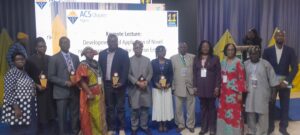
Highpoint of the event was the presentation of awards to deserving individual for their contributions to the field of sciences and particularly, chemistry.