By Adeyinka Adeniran
The United Nations Children Fund (UNICEF) and the National Population Commission (NPC) have urged media practitioners to lend a voice to the challenges associated with non registration of birth of children in the country, particularly in the Southwest region.
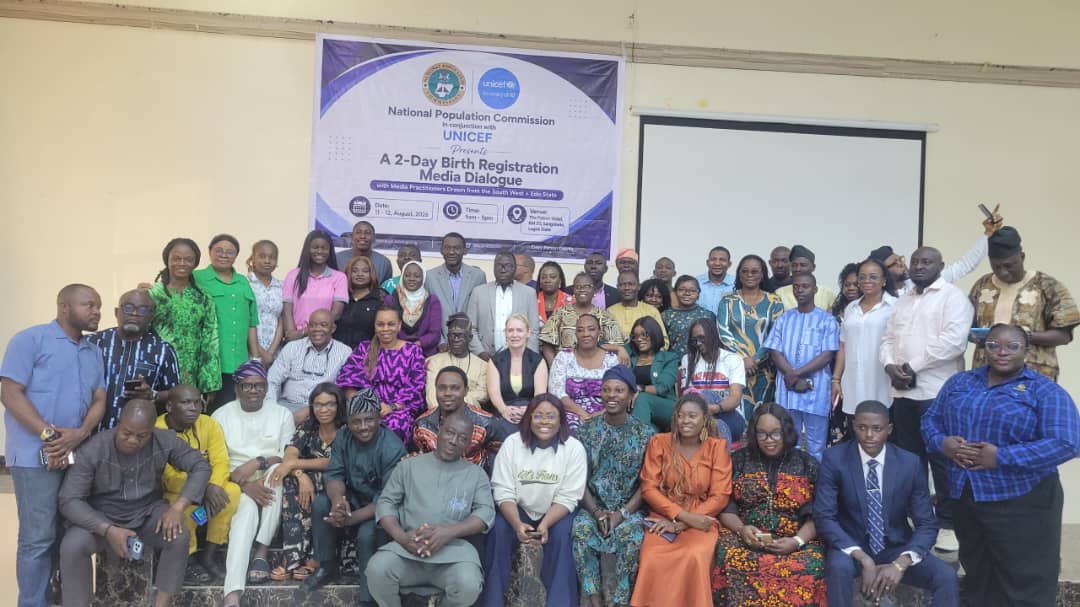
They made the appeal on Tuesday at the opening of a 2-day Birth Registration Media Dialogue organised by the NPC in collaboration with UNICEF for media practitioners drawn from the Southwest states of Lagos, Oyo, Ogun, Osun, Ondo and Ekiti as well as Edo state.
The dialogue is holding at Patron Hotel, Sangotedo, Lagos State.
In her opening remarks, the Chief of UNICEF Lagos Field Office, Celine Lafoucriere giving a background to the various challenges and situation created by non registration of birth said media practitioners through their stories can change things.
She noted that, across the various states, some babies born in the morning will end the day with no name on any government record, stressing that the staggering figure is put at about 3.5 million children with no birth certificate, no legal identity, and no proof on any record that they were ever born across Lagos, Ogun, Oyo, Osun, Ondo, Ekiti, and Edo states.
She maintained that many children across the six Southwest states and Edo have no birth certificate, no name on paper, no proof they exist, children whom the system cannot see, warning that a birth certificate is not a piece of paper, but a child’s ticket into school.
Lafoucriere said, “I am aware you have various beats that you cover – health, education, politics and crimes… But first, let me ask, when was the last time you wrote or reported about children who do not exist on the state or national record? I’m not talking about missing children. Nor am I talking about orphans.
“I am talking about children who are alive, at home, loved by their families, but completely invisible to their state and the country.
“Right now, across your various states, some babies born even this morning will end this day with no name on any government record. This translates to 3.5 million children with no birth certificate, no legal identity, and no proof on any record that they were ever born across Lagos, Ogun, Oyo, Osun, Ondo, Ekiti, and Edo states.
“Here is the number I want you to remember for the next two days: 3.5 million. That is how many children across the six Southwest states and Edo that have no birth certificate, no name on paper, no proof they exist, children whom the system cannot see.
“Some are in cities. Some are in villages. Some were born in hospitals and still never got registered. The gap is everywhere.
“A birth certificate is not a piece of paper. It is a child’s ticket into school. It is what allows a doctor to put a name on a patient file. It is how a family proves their child is theirs. Without it, a child cannot vote when they grow up, cannot get a passport, or cannot inherit land. They go through life, having to prove they exist over and over again.”
She however commended the Lagos State government, working with the NPC on the progress made so far.
“But let me also say that there has been real progress in this region. For instance, Lagos State, working with the National Population Commission and ALGON, was among the first states in the south to formally launch the birth registration exercise for children under one.
“The birth certificate now comes with a National Identification Number. That is a meaningful step forward. But progress and completion are two different things.
“In every state represented in this room, the gap between children who are registered and children who are not is still too wide. That is where you come in. You are here because this story needs you.
“The families who have never registered their children are not ignoring the system out of stubbornness. Many of them do not know that registration is free. Many do not know that they can do it at the nearest health clinic. Many do not know that it can now be done on a tablet in their community. They do not know because no one has told them in a language they trust, on a platform they use, in a voice that sounds like their own.
“Your story can change all that with those stories only you can tell about a real mother, a real child, a real clinic. That is what moves people, and that is what this dialogue is designed to help you produce.
“We have two days together. Use them well. Ask hard questions, get the interviews done, talk to parents, and the agencies concerned. Find the children behind the statistics and depart from here to write the stories that need to be written.
The children are counting on you to tell their stories, and UNICEF is here to support that work.”
Also speaking, Lagos State Director of NPC, Kekere-Ekun Abiola charged the media practitioners to utilize their platforms for advocacy and dissemination regarding birth registration.
In his remark, Kekere-Ekun noted that while manual procedures were used in the past alongside partial electronic methods, operations have now shifted entirely to full digitalization, making birth attestations and certificates digital and online.
He emphasized that media support is needed more than ever to reach down to the nooks and crannies of society to highlight the importance of birth certificates.
Addressing the impact of civil registration, the NPC Director stressed that every child must be counted, warning that a child without a birth certificate is deemed invisible, remains unknown to the government, and cannot be accounted for or planned for until they possess a certificate.
He highlighted past collaborative successes with the Ministry of Education and Ministry of Health, and urged media partners to help stimulate and advocate for the initiatives at the grassroots level.
Looking at registration projections, the commission noted that the projection as of 2024 stood at 54 percent, while UNICEF placed it at 43 percent adding that, with nationwide operations now digitalized, expansion is set to begin immediately, followed by acceleration in subsequent years, with the ultimate goal of achieving the Sustainable Development Goal (SDG) target of 6.9 for total birth registration by 2030.
Speaking on the objective of the media dialogue, the Communication Officer, UNICEF Lagos Field Office, Blessing Ejiofor, stressed the need for sustained media coverage of birth registration
Outlining the key objectives for a media dialogue on birth registration, she urged journalists to develop a deeper, data-driven understanding of the challenges surrounding the registration of children in Southwest Nigeria and Edo State.
Ejiofor said the engagement is designed to help journalists understand what birth registration means, why millions of children remain unregistered and the implications of lacking official documentation of birth. She also highlighted the importance of understanding the electronic birth registration (e-BR) system and how it operates.
According to her, journalists will learn about the role of National Population Commission (NPC) registrars, the information contained in digital birth certificates and the significance of the National Identification Number attached to the certificates.
“The dialogue will equally provide opportunities for journalists to establish direct contacts with NPC officials, UNICEF, community registrars, health workers and parents who have experienced the registration process”, she said
The UNICEF communication officer further encouraged participating journalists to translate the knowledge and contacts gained from the dialogue into impactful stories.
She said journalists are expected to identify story angles, choose suitable formats and develop story synopses for reports that can be published or broadcast within 30 days. Beyond producing individual reports, the initiative seeks to promote sustained media attention and build a network of journalists who will continue to keep birth registration on the public agenda.